Go
Go gets code intelligence from gopls, runs and tests with the go command,
and debugs with Delve.
Language server
Go’s language server is gopls. Editora finds it on the PATH or installs it
for you; see language servers.
Running
Run File (file.run: C-c r in the Emacs keymap, Ctrl+Shift+B (⌘⇧B on macOS) in VS Code) runs a Go file that has
package main and a func main(). Editora saves the file, and the module’s
other edited Go files, then builds the program with go build into its cache
folder and runs it in the file’s folder:
- A file of a module (a
go.modin its folder or above) builds its package, asgo run .does. - A file outside any module is built alone, as
go run file.godoes.
The build command and the program’s output stream into the Run window.
File: Run with Arguments… (file.runWithArgs) asks for the program’s
arguments; they are kept for that file and used by every later Run File.
Rerun Last builds and runs it again. Go builds don’t ask you to
trust the folder. A file on a
remote host doesn’t run.
Tests
In a _test.go file, Run Test at Caret (test.runAtCaret) builds the
package’s test binary (go test -c) and runs the test function the caret is
in (-test.run ^Name$ -test.v), or every test of the package when the caret
is outside a test function. Its output goes to the Run window. A
Benchmark… function runs nothing this way, since -test.run matches tests
only: run it with Debug Test at Caret, which runs it as a benchmark. Run
File on a _test.go file runs the package’s tests.
Run Tests (test.run) in a Go module runs go test -json ./... and fills
the Test Results window, where failed tests
can be run again. Debugging a test is described under Debugging.
Debugging
Go is debugged with Delve, the debugger
VS Code’s Go extension uses. Debug a Go file with Debug: Start / Continue
(debug.start: C-c C-d d in the Emacs keymap, F5 in the VS Code, CUA and
Sublime Text keymaps, Shift+F9 (⌃D on macOS) in the IntelliJ IDEA keymap), or with
Debug File in the editor’s right-click menu:
- A file of a module (a
go.modin its folder or above) debugs its package, asgo run .runs it. - A file outside any module is debugged alone, as
go run file.goruns it. - In a
_test.gofile, Debug and Debug Test at Caret (test.debugAtCaret) run the test function the caret is in on its own (aBenchmark…function runs alone as a benchmark), and every test of the package when the caret is outside a test function.
Restart runs the same program or test again, wherever the caret is by
then. The arguments set by File: Run with Arguments… (file.runWithArgs)
are passed to the program, or to the test binary.
Delve builds the program itself, with optimizations off, using the go that the
Go build tool runs. It builds from the files on disk, so
Debug and Restart save the package’s edited Go files first. Its build goes to
the temporary folder, so no __debug_bin file is left in your package. The
program’s output reaches the Debug console.
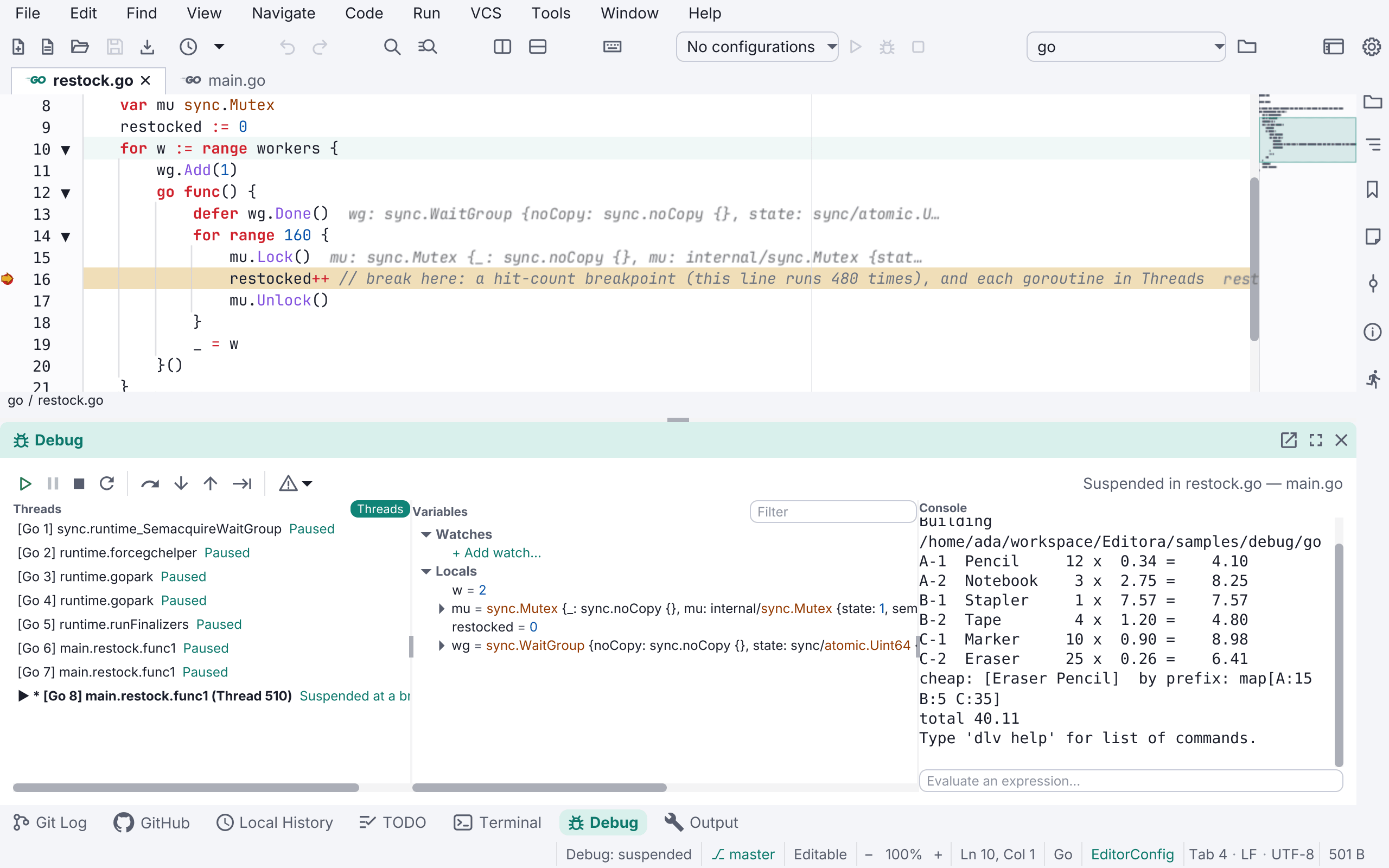
- Breakpoints take conditions, hit counts and log messages. A line that holds only a comment takes none.
- Stepping, Variables, Watches, hover values and inline values work. A struct, slice or map unfolds to its fields or items.
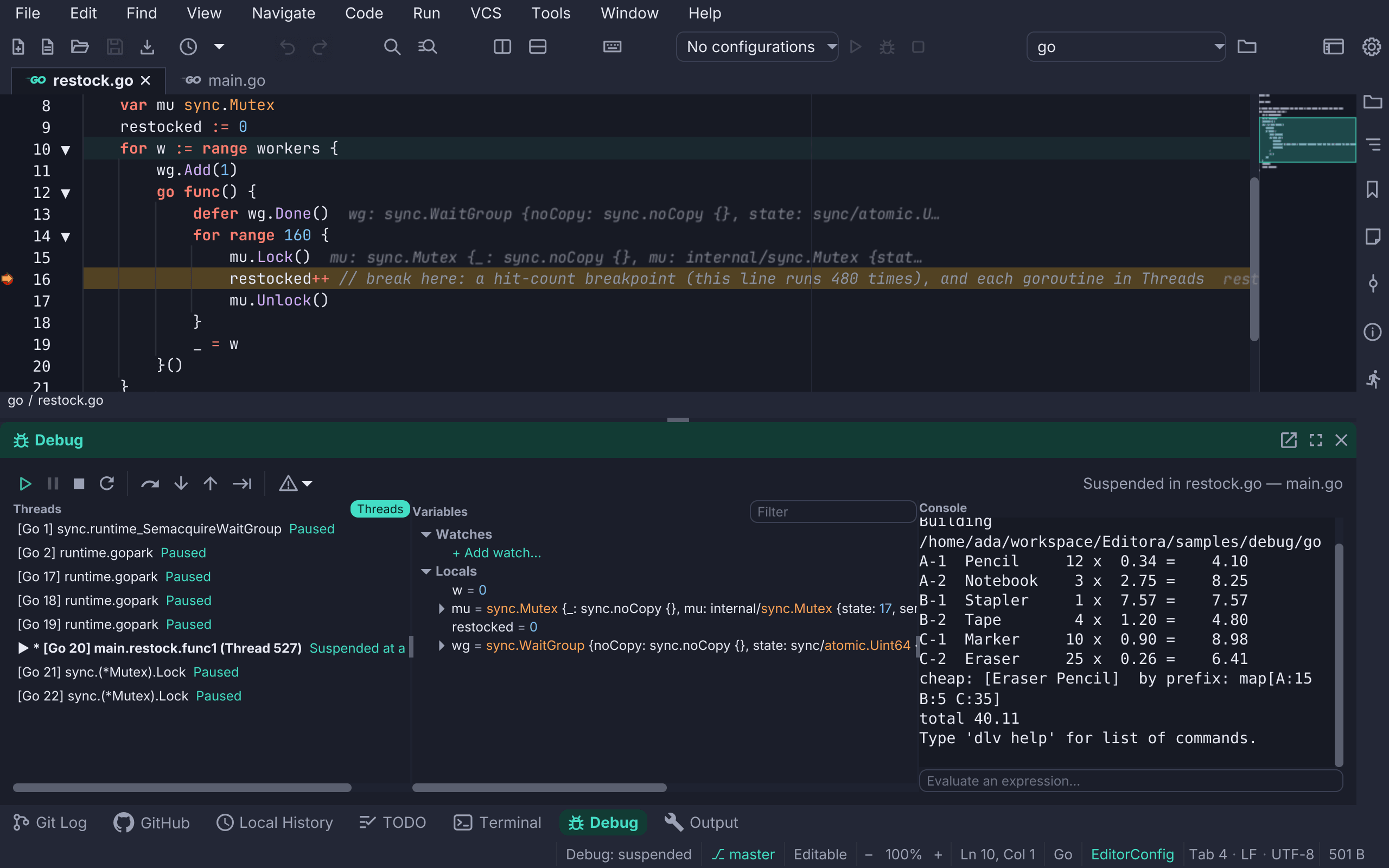
- Goroutines are threads. The call stack’s thread list and the
Threads view name each one, such as
[Go 6] main.restock.func1. Delve lists at most 1024 goroutines. See Goroutines for which are listed. - A panic stops the program where it happened. Delve does that by itself, so Go has no exception breakpoints to choose.
Attach to Process attaches Delve to a Go program that is already running, on Linux and macOS. Stop leaves that program running. Open Core Dump opens the core a crashed Go program left in Delve.
Goroutines
The Threads view lists your program’s goroutines. The runtime’s own, such as
the garbage collector’s workers, the finalizer and the scavenger, are left out.
A goroutine started under pprof labels (pprof.Do) shows them in its name:
[Go 20 job:resize-0] main.worker.
Right-click the Threads view for:
- Hide Runtime Goroutines (
debug.toggleRuntimeGoroutines): untick it to list the runtime’s goroutines again. - Filter Goroutines… (
debug.filterGoroutines): list only the goroutines that Delve’s own filter keeps, such as-with label job=*,-without go runtime.*or-with user. Empty lists every goroutine.
Both apply to the running program at once and are kept. A filter can leave out the goroutine the program stopped on.
Go goroutines in Settings → Debugging holds the same choices:
Hide runtime goroutines (on), pprof labels in names (* for every
label, or the keys to show, such as job, region; empty shows none, from the
next session on) and Goroutine filter.
Installing Delve
Delve isn’t bundled. Editora finds dlv as set on the Go (Delve) card of
Settings → Debugging, else on the PATH, else where go install puts it
($GOBIN, $GOPATH/bin or ~/go/bin), so a Delve installed while Editora runs
is found too. The card’s Install… runs
go install github.com/go-delve/delve/cmd/dlv@latest, which needs Go. Without
Delve, Debug says Delve (dlv) was not found and how to get it. The card’s
switch, Enable Go debugging (Delve), is on by default, and the
Doctor checks for Delve.